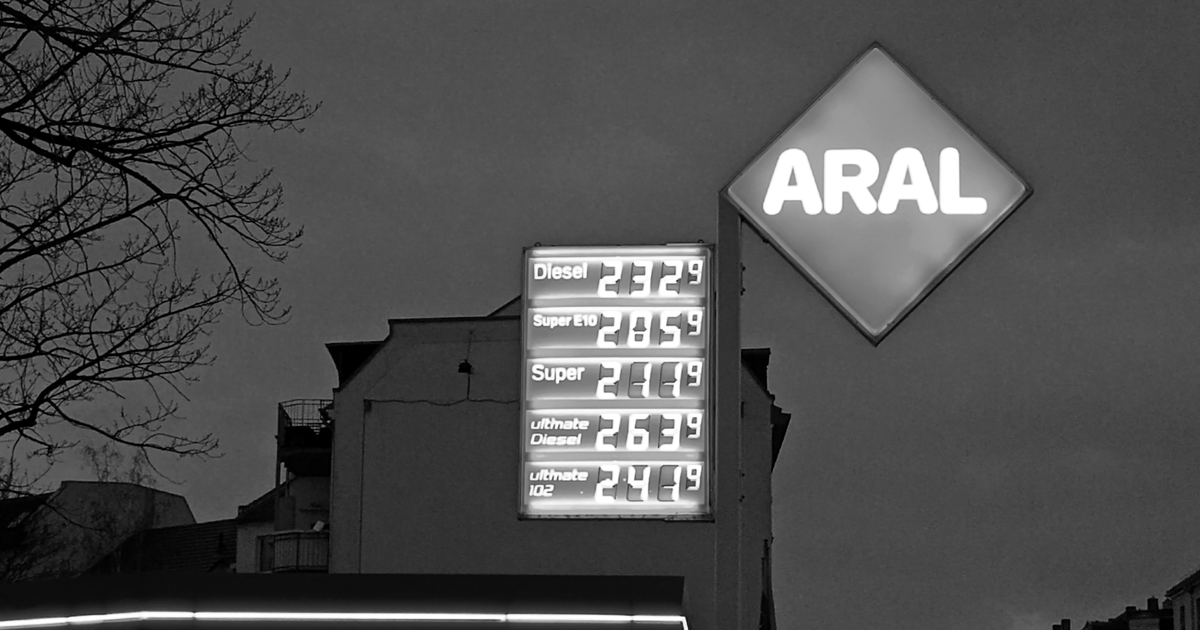
Filling up a car in Germany has become noticeably more expensive this week. A litre of Super E10 petrol now costs €2.083 on average nationwide, up 5.9 cents on last week, while diesel jumped 11.7 cents to €2.070, according to the weekly price analysis by the ADAC, Germany’s largest automobile club. The trigger is the renewed escalation in the Persian Gulf, which has pushed oil prices to their highest level in about a month — and the increase is arriving just as the school-holiday travel season gets under way in several German states.
The prices at a glance
- Super E10: €2.083 per litre on average — up 5.9 cents in a week (ADAC).
- Diesel: €2.070 per litre — up 11.7 cents in a week, one of the sharpest weekly rises in months.
- Diesel vs. petrol: the gap has shrunk to just 1.3 cents — diesel’s usual price advantage has almost vanished.
- Why: oil prices at a roughly one-month high after the escalation around the Strait of Hormuz.
- When it hit: diesel rose 6.2 cents from Tuesday to Wednesday alone — one of the biggest daily jumps in months.
Why prices are climbing
The immediate cause lies far from Germany. The conflict between the United States and Iran has escalated again in recent days: Washington has reimposed a naval blockade on ships travelling to and from Iranian ports, Tehran has declared the Strait of Hormuz closed, and tanker traffic through the strait — the route for roughly a fifth of the world’s oil — has thinned dramatically. Oil markets have responded the way they usually do to trouble in the Gulf: Brent crude has climbed to its highest level in about a month, trading in the mid-80s in US dollars per barrel.
Because Germany imports virtually all of its crude oil, moves like this reach German fuel pumps within days. The ADAC says the recent surge at filling stations is primarily driven by the rising oil price. Diesel reacts even more strongly than petrol, partly because middle-distillate markets — which also supply heating oil and jet fuel — are more sensitive to supply worries.
Diesel’s price advantage has almost vanished
One striking detail in this week’s figures: diesel now costs only 1.3 cents less per litre than Super E10. Diesel is normally taxed more lightly in Germany and typically sells for noticeably less than petrol — that difference is a key reason many high-mileage drivers choose diesel cars in the first place (diesel drivers pay a higher annual vehicle tax in return). When the gap shrinks to almost nothing, the everyday economics of running a diesel temporarily disappear.
Bad timing: the holiday season is starting
The price jump coincides with the start of the summer school holidays (Sommerferien) in several federal states, when millions of households set off by car for the coast, the mountains or destinations abroad. For a typical 50-litre tank, this week’s increase alone adds roughly €3 to €6 per fill-up compared with last week — and prices were already high before the latest jump.
What it means for people living in Germany
You cannot control the oil price, but in Germany you can control when and where you buy fuel, and the differences are surprisingly large. A few practical rules from the ADAC’s long-running price research:
- Fill up in the evening. Fuel is typically cheapest between about 6 pm and 10 pm; early morning is usually the most expensive time of day. The difference can reach several cents per litre.
- Use a price app. All German filling stations must report their prices in real time to a government-mandated transparency service (Markttransparenzstelle). Free apps such as the ADAC Drive app or clever-tanken show the cheapest station near you.
- Avoid motorway stations. Fuel directly on the Autobahn is routinely far more expensive than at stations a few minutes off the motorway — leaving at an exit to refuel usually pays off.
- Compare across the street. Prices at different stations in the same town can differ by 10 cents or more at the same moment.
- Consider skipping the car. For trips within Germany, the Deutschlandticket flat-rate pass covers all regional and local public transport nationwide — with prices at this level, it beats driving on many routes.
Will it get worse?
That depends almost entirely on the Gulf. Analysts note that global oil supply is not acutely short — other shipping routes remain open, and producers hold spare capacity — so the current surge reflects a risk premium more than a physical shortage. If the situation around the Strait of Hormuz calms, pump prices should ease again; if the confrontation escalates further, another leg up is possible. The ADAC has repeatedly pointed out that pump prices tend to rise quickly when oil climbs and fall much more slowly when it drops — so it is worth watching prices closely in the coming weeks rather than assuming relief will arrive on its own.
Understand Germany, in plain English. Sign up for The New German newsletter for the news that matters to internationals living here.
Leave a Reply