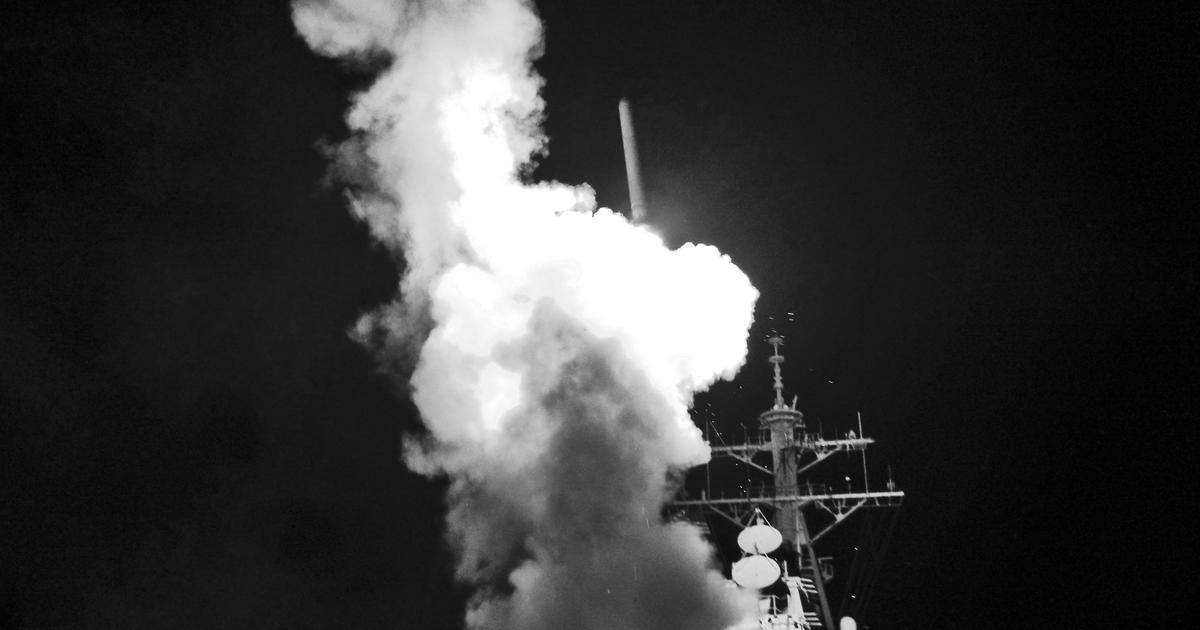
Germany will buy American Tomahawk cruise missiles and station them on German soil — a deal agreed behind closed doors at the NATO summit in Ankara and kept under wraps for days before Chancellor Friedrich Merz confirmed it in the Bundestag on Thursday. It is one of the most consequential German arms purchases in decades, and a first: no country outside the United States has ever operated the ground-launched version of the weapon.
- What: Germany buys U.S.-made Tomahawk cruise missiles plus ground-based Typhon launchers, to be stationed in Germany.
- Scale: Reportedly up to 400 Tomahawk Block Vb missiles worth more than $1 billion — exact numbers are classified.
- Range: Over 1,600 km, enough to reach targets deep inside Russia from German territory.
- When agreed: A letter of intent was signed on Tuesday at the NATO summit in Ankara — and stayed secret until Thursday.
- What’s next: Formal U.S. export approval is expected in August.
A deal that stayed secret for days
The agreement was reached on the sidelines of the NATO summit in Ankara on July 7–8, where a letter of intent was signed on Tuesday, according to German government sources cited by Reuters and Der Spiegel. Neither Berlin nor Washington said a word publicly until Merz stood before the Bundestag two days later.
“This will close an important strategic gap in our defense,” the chancellor told parliament, “and at the same time, we will work to develop our own European systems and station them in Europe.”
The secrecy was no accident. Washington had rebuffed earlier German attempts to buy the weapon, and the Kremlin had lobbied hard against the sale, arguing it would be a dangerous escalation. Announcing the deal only once it was signed left no room for it to be talked down.
What Germany is buying
The Tomahawk is America’s best-known cruise missile: a subsonic, precision-guided weapon that flies at around 30 metres above the ground to evade radar, with a range of well over 1,600 kilometres. Berlin is reportedly seeking up to 400 missiles of the newest Block Vb variant, which carries a multi-effects warhead and can be re-targeted mid-flight via a two-way datalink.
To fire them from land, Germany will also buy the U.S. Army’s Typhon launcher — a containerised, truck-mobile system that can also fire the SM-6 missile and, in future, hypersonic weapons. How many launchers and missiles the Bundeswehr will actually procure, and when they will arrive, remains classified.
The purchase is a leap in capability. The German army’s longest-range missile artillery today, the MARS II rocket launcher, reaches about 70 kilometres. The Tomahawk multiplies that reach more than twentyfold — from Germany, it puts targets deep inside Russia within range.
From hosting American missiles to owning them
The deal marks a sharp change of course. In 2024, then-Chancellor Olaf Scholz and President Joe Biden agreed that the United States would station Tomahawks and other long-range missiles in Germany from 2026, operated by a U.S. Army task force. That plan effectively collapsed this spring amid a rift between Berlin and Washington, when the Pentagon shelved the deployment and announced the withdrawal of 5,000 U.S. troops from Germany.
Buying the missiles outright means Germany no longer depends on an American deployment decision that can be reversed. It is also a vote of limited confidence in long-term U.S. security guarantees: Merz has framed the purchase explicitly as an interim solution until European alternatives exist. Germany is part of the Franco-led ELSA programme for a European long-range missile planned for the 2030s, and has a separate project with the United Kingdom for a strike weapon with a range beyond 2,000 kilometres.
Echoes of the 1980s
For Germans with long memories, ground-launched Tomahawks are a loaded symbol. An earlier version of exactly this weapon — the BGM-109G Gryphon — was stationed in West Germany in the 1980s and drew some of the largest protests in the country’s history, before the 1987 INF Treaty banned the entire category of land-based intermediate-range missiles.
That treaty is gone: the United States withdrew in 2019, citing Russia’s deployment of the prohibited 9M729 cruise missile, and Moscow has since fielded new intermediate-range weapons, including the Oreshnik ballistic missile used against Ukraine. It is this arsenal — and the absence of any European counterweight to it — that Berlin calls the “strategic gap.”
What it means for people living in Germany
Nothing changes in daily life, but the political debate will be loud. Expect arguments over where the launchers will be based (no locations have been named), what the purchase means for the defence budget, and whether the missiles deter Russia or provoke it — the same dispute that filled German streets four decades ago. The Left Party and parts of the SPD have long opposed stationing long-range missiles in Germany; the government’s counter-argument is that deterrence prevents war rather than inviting it.
The next milestone comes in August, when the formal U.S. export approval is expected. Only then will Berlin say more about numbers, cost and timelines — if it says anything at all.
Reporting based on Der Spiegel, Reuters, Bloomberg and The War Zone.
Understand Germany, in plain English. Sign up for The New German newsletter for the news that matters to internationals living here.
Leave a Reply